
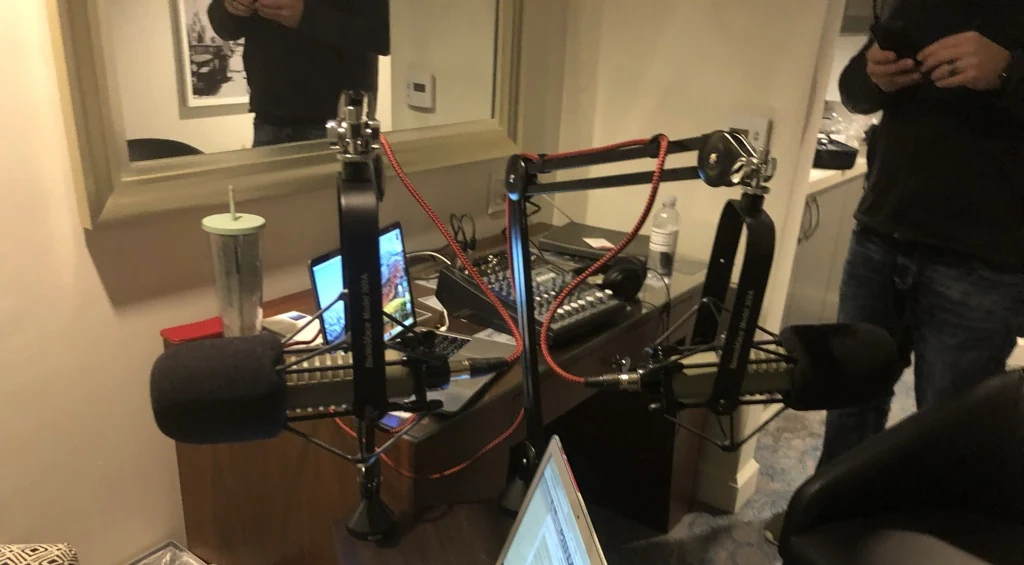
Two boom microphones. A mixer, headphones and laptops spread across a hotel-room desk. Cables everywhere. Bob Ruff leaning over the equipment to get the recording right. It is not a polished studio portrait, and that is exactly why I like these photographs. They show the work behind the conversation.
This episode began with my UC San Diego Division of Extended Studies Influencer Marketing students. They submitted the questions, and Truth & Justice host Bob Ruff invited me to guest host a Friday Follow-Up while he was on the road. I expected a useful conversation for the class. What we recorded was also a close look at how a host earns trust when the audience is not simply consuming a story but evaluating evidence, participating in the reporting process and caring about real people.
I remain grateful to Bob for opening that process to the class.
Hear the episode
Truth & Justice released this Friday Follow-Up on March 8, 2019. Bob invited me to guest host, and I brought the questions my UCSD students had submitted. The episode remains part of Bob’s podcast history; this page adds my photographs and the perspective I bring to it now.
- Hear S6 Ep29: S6:E29 Follow-Up
- Find Truth & Justice on Apple Podcasts
- Find Truth & Justice on Spotify
Recorded for Truth & Justice with questions from my UCSD students.
What the students wanted to know
The students were not looking for a success story polished after the fact. They wanted to understand the choices behind the audience:
- How does a host earn authority over time?
- What responsibility comes with mobilizing public attention?
- How should a creator distinguish reporting, interpretation and advocacy?
- What makes an audience participate rather than merely listen?
- What happens to trust when the evidence changes?
Those questions feel even more important now. True-crime podcasts can expose overlooked evidence and invite public participation. They can also turn grief, violence and uncertainty into entertainment. Current journalism and university work on true-crime ethics keeps returning to the same responsibilities: center the people affected, rely on primary evidence, avoid sensationalism and remember that an audience’s curiosity does not erase a subject’s humanity.
That does not make every host a journalist or every listener an investigator. It does mean influence in this setting has consequences.
Why I am listening back now

I am revisiting these interviews because they capture questions I was already asking through teaching, journalism and early social-media work: who gets believed, how audiences decide to participate and what changes when attention becomes collective action.
Some of the links around my old website aged. Bob’s episode did not disappear, and neither did the central issue.
A podcast audience develops its own expectations, habits and informal rules. Sociologists might describe some of these as norms or folkways: learned ways of behaving that become ordinary inside a group long before anyone writes them down. Psychology helps explain motivation, identification and trust. Anthropology asks us to look at the meanings a community creates together. Marketing metrics can describe the size and activity of the audience, but those other lenses help explain what participation means.
This appearance is separate from my own podcast archive. I am revisiting it because guest appearances can show a different side of the work: the questions I bring into someone else’s format, what I notice about that audience and what still feels unsettled years later.
The most interesting question was never how many people were listening. It was what the relationship between a host and an audience made possible.
Sources and listening notes
- University of Texas at Austin, The Evolution and Ethics of True Crime Journalism, April 6, 2025.
- Newcastle University, Creating a new code of conduct for true crime content, May 21, 2025.
- This interview interview originally aired on the Truth & Justice podcast in March 2019.
For speaking, media, teaching or institutional inquiries, contact Jennifer Neeley.
Continue with Teaching & Executive Education, Speaking & Media, The Influence Project and About Jennifer.

